
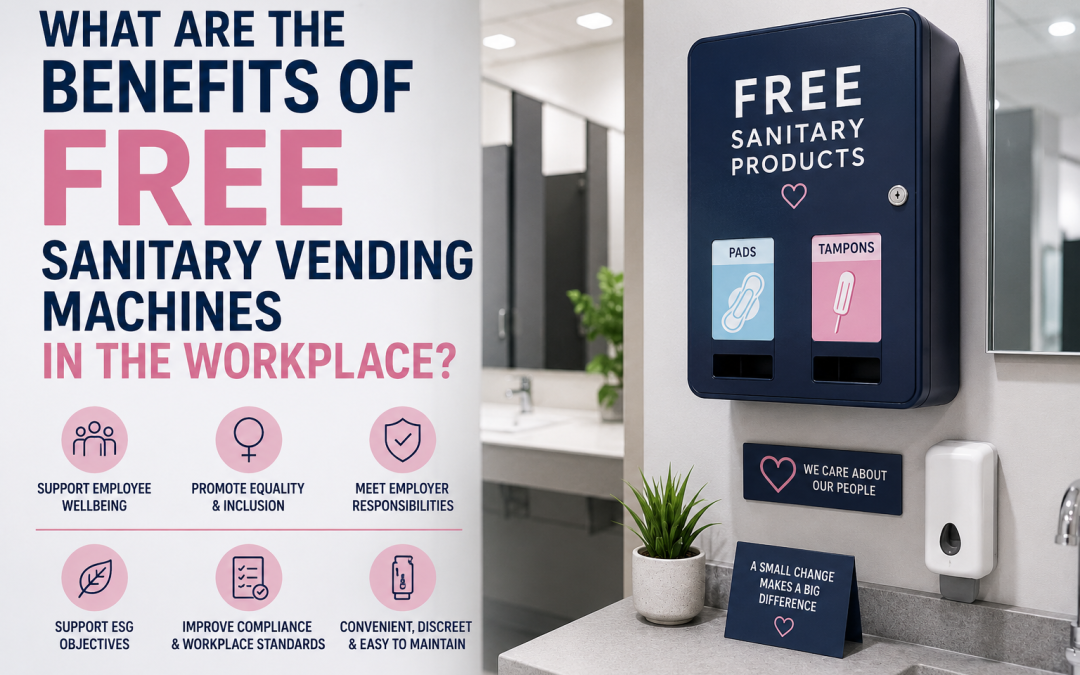
Free sanitary vending machines give employees convenient access to period products when they need them, helping to create a more inclusive, comfortable and supportive workplace. Key benefits include improved employee wellbeing, reduced period-related stress, better washroom provision, support for equality and ESG objectives, and a simple way for employers to demonstrate that employee welfare is taken seriously.
For many organisations, providing period products is becoming a natural extension of the essential washroom facilities already available to employees.
Unexpected periods, forgotten products or a lack of access to suitable facilities can cause unnecessary stress during the working day. Providing free sanitary products directly within workplace washrooms offers a practical solution.
With modern sanitary vending solutions, businesses can make essential period products readily available while maintaining a professional, discreet and easy-to-manage washroom environment.
What Is a Free Sanitary Vending Machine?
A free sanitary vending machine is a washroom dispenser that provides sanitary products such as tampons and pads to users without requiring payment.
Unlike traditional coin-operated vending machines, employees do not need cash, a card or another payment method to access the products.
The dispenser is installed within or close to workplace washroom facilities and regularly replenished to ensure products remain available.
This creates a simple system: if an employee unexpectedly needs a sanitary product during the working day, they can access one immediately and discreetly.
For employers, it provides a straightforward way to improve workplace washroom facilities without introducing complicated processes for staff.
Why Should Employers Provide Free Period Products?
Providing period products can help remove a small but potentially significant source of stress from the working day.
An employee may arrive at work without the products they need, experience an unexpected period or simply run out during the day.
Without suitable products available, they may need to leave the workplace to visit a shop, ask a colleague or improvise until they can obtain what they need.
All of these situations can cause unnecessary discomfort and embarrassment.
Free sanitary vending provides immediate access to essential products in the environment where they are needed.
The principle is similar to providing toilet paper, soap and hand drying facilities. These are basic washroom essentials employees expect to be readily available.
As workplace expectations continue to develop, more organisations are beginning to consider period products as another important element of a well-equipped washroom.
What Are an Employer’s Responsibilities?
UK employers have responsibilities relating to workplace health, safety and welfare, including providing suitable and sufficient toilet and washing facilities.
There is not currently a universal legal requirement for every private-sector employer in the UK to provide free period products to employees.
However, providing them can form part of a wider approach to employee welfare, equality, dignity and inclusive workplace facilities.
Employers should consider whether their washrooms appropriately meet the needs of the people using them.
This can include the availability of suitable sanitary disposal facilities alongside access to period products.
Professional washroom services can help businesses manage these requirements and maintain clean, hygienic and appropriately equipped facilities.
Supporting Workplace Wellbeing
Employee wellbeing is about more than major workplace policies and initiatives.
Small practical improvements can also make a noticeable difference to people’s everyday experience at work.
Access to period products is a good example.
For someone who unexpectedly needs a tampon or pad, knowing that products are freely available can remove immediate stress and allow them to continue their working day comfortably.
This can contribute to a workplace culture where employees feel their basic needs have been considered.
Providing period products can also help normalise conversations around menstruation.
Periods are a normal part of life, yet they can still be associated with embarrassment in professional environments.
Making sanitary products routinely available helps treat them as what they are: essential hygiene products.
Helping Reduce Period-Related Disruption
Lack of access to period products can also disrupt the working day.
An employee who needs to leave work temporarily to purchase products may lose working time and experience unnecessary inconvenience.
Depending on the workplace location, obtaining products may not be quick or easy.
This can be particularly relevant for:
-
Factories
-
Warehouses
-
Distribution centres
-
Construction environments
-
Offices on industrial estates
-
Remote workplaces
-
Large commercial sites
-
Educational environments
Installing free sanitary vending machines provides immediate access without employees needing to leave the premises.
For businesses with large workforces, shifts or sites operating outside conventional retail hours, this can be especially useful.
Supporting Equality and Inclusion
Providing period products can also contribute to wider equality, diversity and inclusion initiatives.
Not every employee has the same requirements from workplace facilities.
An inclusive workplace considers those differences and looks for practical ways to make the working environment accessible and comfortable for everyone.
Free sanitary products are a relatively simple facility that can demonstrate this principle in practice.
Rather than requiring employees to ask a manager, colleague or reception desk for assistance, products can be accessed privately within the washroom.
That privacy is important.
A well-designed sanitary vending solution allows employees to access what they need without explaining their personal circumstances to anyone else.
How Can Sanitary Vending Support ESG Objectives?
Environmental, Social and Governance, or ESG, has become increasingly important for organisations assessing their wider impact and responsibilities.
Free sanitary provision is particularly relevant to the social element of ESG.
Social considerations can include employee wellbeing, equality, working conditions, accessibility and how an organisation supports its workforce.
Providing essential period products will not create an ESG strategy by itself, but it can form part of a broader programme of practical improvements designed to support employees.
It provides businesses with a visible example of investment in workplace welfare.
Organisations can also consider the environmental impact of the products and services they select, including packaging, servicing arrangements and waste disposal.
Free Vending vs Coin-Operated Sanitary Machines
Traditional sanitary vending machines often require employees to pay for products.
While this provides access, it can still create barriers.
Employees may not carry coins, particularly as cashless payments have become increasingly common.
Free vending removes that issue entirely.
The employee simply accesses the product when required.
This makes the service easier and can help reinforce the idea that sanitary products are an essential washroom provision rather than an optional purchase.
For employers, free vending can also eliminate the need to manage cash collection and payment mechanisms.
Where Should Sanitary Vending Machines Be Installed?
Accessibility and discretion should be priorities when deciding where to install a sanitary vending machine.
The most logical location is normally within toilet or washroom facilities.
This allows employees to access products privately and immediately.
Businesses with larger premises may require several dispensers to provide convenient coverage.
When planning installation, employers should consider:
-
Number of employees
-
Number of washrooms
-
Building layout
-
Shift patterns
-
Accessibility
-
Expected product usage
-
Available wall space
-
Servicing requirements
A professional washroom provider can assess the site and recommend an appropriate arrangement based on workforce and facility requirements.
Are Sanitary Vending Machines Difficult to Maintain?
Free sanitary vending machines are designed to provide a straightforward workplace solution.
The primary ongoing requirement is ensuring the dispenser remains stocked, clean and operational.
The appropriate replenishment frequency will depend on the number of employees and level of usage.
A small office may use relatively few products, while a large workplace with hundreds of employees may require more regular servicing.
Usage should therefore be monitored after installation.
This allows stock levels and servicing schedules to be adjusted to reflect actual demand.
Businesses using a managed washroom service can incorporate sanitary vending into their existing servicing arrangements, reducing the amount of administration required internally.
Don’t Forget Sanitary Waste Disposal
Providing sanitary products is only one part of creating suitable workplace washroom facilities.
Employees also need a hygienic and discreet method of disposing of used products.
Appropriate sanitary waste disposal helps businesses maintain cleaner facilities while ensuring sanitary waste is collected and managed correctly.
Product provision and waste disposal should therefore be considered together.
A well-equipped workplace washroom should make the complete process as straightforward and discreet as possible, from accessing a product to disposing of it after use.
Which Workplaces Can Benefit From Free Sanitary Vending?
Almost any organisation with employees or visitors can potentially benefit.
This includes:
-
Offices
-
Factories
-
Warehouses
-
Schools and colleges
-
Universities
-
Healthcare environments
-
Hospitality venues
-
Leisure centres
-
Retail premises
-
Public buildings
-
Commercial facilities
The business case can be particularly strong for organisations employing large numbers of people or operating across long shifts.
Providing products can also benefit customers and visitors.
For venues with significant public footfall, free sanitary provision can improve the overall washroom experience and demonstrate greater consideration for visitors’ needs.
Frequently Asked Questions About Free Sanitary Vending Machines
Are employers legally required to provide free sanitary products in the UK?
There is not currently a general legal requirement for every private-sector UK employer to provide free sanitary products. However, employers do have responsibilities regarding suitable workplace welfare and washroom facilities. Many businesses choose to provide period products as part of their wellbeing, equality and inclusion initiatives.
What products can a sanitary vending machine provide?
Sanitary vending machines can typically dispense essential period products such as sanitary pads and tampons. The exact products available will depend on the dispenser and service selected.
Do employees have to pay?
Not with a free sanitary vending machine. Products are supplied without requiring coins or another form of payment, allowing employees to access them immediately when needed.
Where should a sanitary vending machine be installed?
Dispensers are generally most useful inside or immediately adjacent to toilet and washroom facilities, where employees can access products privately and discreetly.
How often do sanitary vending machines need refilling?
This depends on workforce size and usage. Stock levels should be monitored so that replenishment can be scheduled before products run out. A managed service can make regular replenishment part of the workplace’s washroom servicing schedule.
Can large workplaces have multiple dispensers?
Yes. Large offices, factories, warehouses and multi-floor buildings may benefit from installing dispensers in several washrooms to make products easily accessible throughout the site.
Do you also need sanitary waste bins?
Suitable sanitary waste disposal should be provided so employees have a hygienic and discreet method of disposing of used period products. Product provision and sanitary waste management work best as part of a complete washroom solution.
Creating Better Workplace Washrooms
Providing free sanitary products is a relatively small workplace improvement that can have a meaningful impact on employees.
It provides immediate access to essential products, supports employee wellbeing, helps reduce unnecessary disruption and contributes to a more inclusive working environment.
For employers developing wellbeing, equality or ESG initiatives, free sanitary vending can also provide a practical example of those commitments being translated into everyday workplace facilities.
The most effective solution will depend on workforce size, building layout and expected usage. Installation, replenishment and sanitary waste disposal should therefore be considered together rather than as separate requirements.
Hygenie Washrooms provides professional washroom services for businesses looking to create clean, hygienic and appropriately equipped facilities.
Contact Hygenie Washrooms to discuss free sanitary vending and workplace washroom requirements.